Process Compressed Air
Contamination of manufactured products such as food, pharmaceuticals, soft drinks by contaminated compressed air could lead to consumer risk and product recall.
Arrange a personal consultation
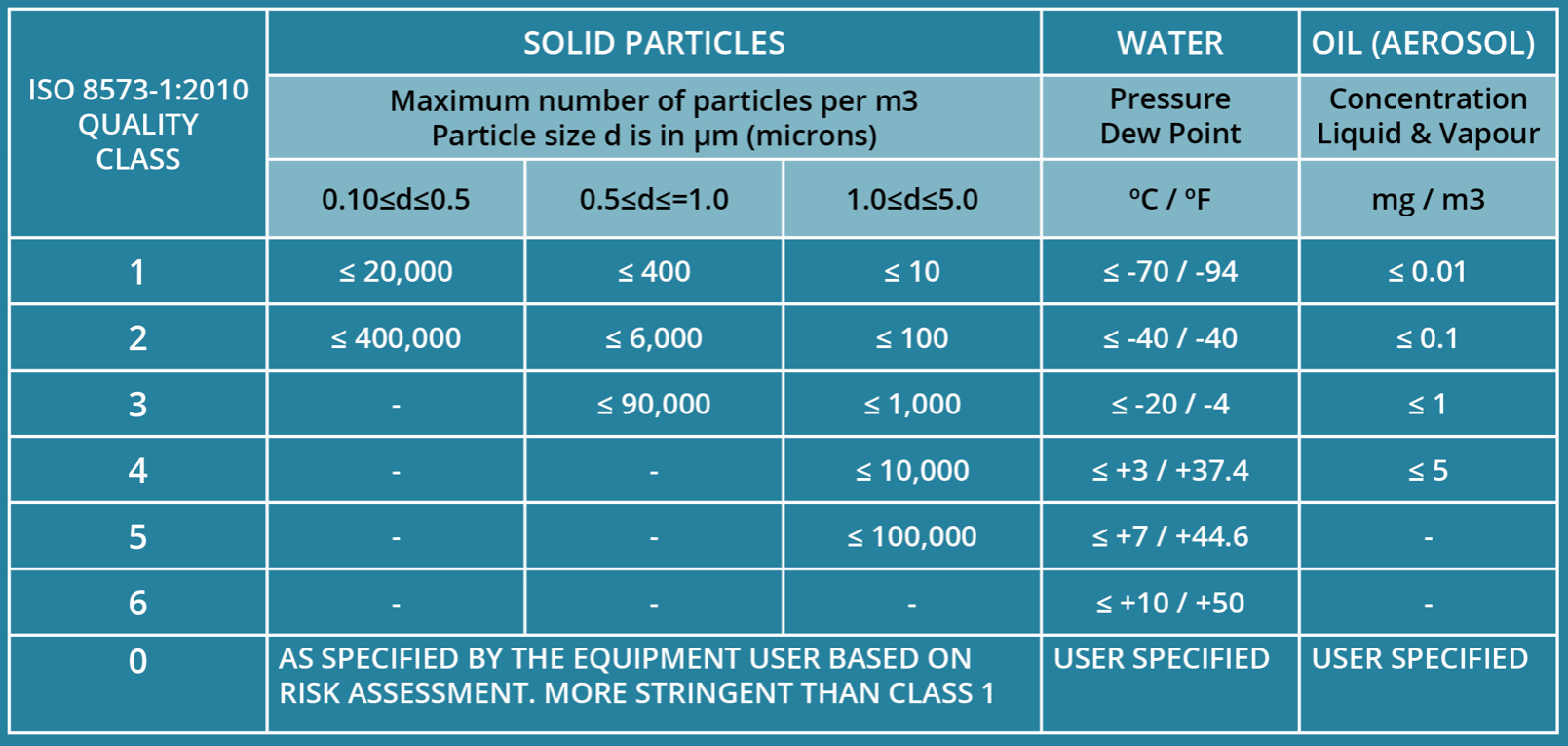

ISO8573-1:2010 Vital Importance of Quality
The quality of compressed air used in industrial processes is specified in the International ISO 8573 standards. It is vital that the quality of compressed air used in your process is in accordance with the required standards to prevent risk to product quality, human health and corporate reputation.
Of the separate parts in the standard, ISO8573-1:2001 part 1 relates to defining the quality of compressed air used in different applications. The other parts are concerned with the methods to test the air for a range of parameters used to indicate the level of contamination. ISO8573-1 specifies purity classes of compressed air in respect of particles, water and oil. The purity classes can be used to describe the current quality of a compressed air system or to specify the required quality for a precise application.
Quality classes according to ISO8573-1 are summarised in the table to the left. ISO8573-2 to 5 specifies test methods for particle, water and oil content in compressed air. Standard test methods ensure that air quality test results are comparable within a given tolerance of measurement.
The test methods are summarised as follows:
Part 2: Test methods for aerosol oil content
Part 3: Test methods for humidity
Part 4: Test methods for solid particle content
Part 5: Test methods for oil vapour and organic solvent
Our Safe Process
To facilitate the ISO8573 process, Safewell has developed the following 4 step approach to compliance:
Step 1: Review in detail your application using compressed air and conduct a risk assessment to assess potential risk to your people, product and/or process. If the existing purity classes in your compressed air system are not known we help you to measure oil, water, bacteria and/or particle content to determine the current quality of the compressed air.
Step 2: Once the current air purity classes are known, we help you compare this with the recognised industry standard requirements of your application. If the purity classes are satisfactory then no further action is required.
Step 3: If work is required we work with your engineering staff to specify the required filtration efficiency for your process based on the outcome of step 1. We use a formula to calculate required filtration efficiency for particles, water, oil aerosols/vapour.
Step 4: We help you select an appropriate compressed air purification system with validated efficiency according to ISO12500.
The schematic to the right provides an example of how we can apply standard products from our Donaldson Range to help clients achieve specific ISO8573 quality classes.
Safewell provides a complete process for evaluation and implementation of solutions to purify compressed air in accordance with the prescribed quality standards. We specify a full range of compressed air purification equipment and integrate these cost effectively to provide a complete solution taking into account factors such as energy efficiency, lifecycle maintenance and cost of ownership.
Our Safe Process
To facilitate the ISO8573 process, Safewell has developed the following 4 step approach to compliance:
Step 1: Review in detail your application using compressed air and conduct a risk assessment to assess potential risk to your people, product and/or process. If the existing purity classes in your compressed air system are not known we help you to measure oil, water, bacteria and/or particle content to determine the current quality of the compressed air.
Step 2: Once the current air purity classes are known, we help you compare this with the recognised industry standard requirements of your application. If the purity classes are satisfactory then no further action is required.
Step 3: If work is required we work with your engineering staff to specify the required filtration efficiency for your process based on the outcome of step 1. We use a formula to calculate required filtration efficiency for particles, water, oil aerosols/vapour.
Step 4: We help you select an appropriate compressed air purification system with validated efficiency according to ISO12500.
The schematic below provides an example of how we can apply standard products from our Donaldson Range to help clients achieve specific ISO8573 quality classes.
Safewell provides a complete process for evaluation and implementation of solutions to purify compressed air in accordance with the prescribed quality standards. We specify a full range of compressed air purification equipment and integrate these cost effectively to provide a complete solution taking into account factors such as energy efficiency, lifecycle maintenance and cost of ownership.

Our Experience
The quality of compressed air used in industrial processes is specified in the International ISO 8573 standards. It is vital that the quality of compressed air used in your process is in accordance with the required standards to prevent risk to product quality, human health and corporate reputation. This is particularly important in the food, drink and healthcare industries.
Safewell works with clients to assess the quality of air required for your process and business sector in accordance with ISO8573. We then work with you to assess whether the existing site air purification system is able to meet these requirements or requires modification and /or maintenance.
Once we are sure that the required quality of air can be achieved on site we work with our clients to schedule a regular testing programme to ensure that the air consistently meets the quality class defined in ISO8573. The quality of the compressed air supply should be tested at least every 3 months or whenever a mobile compressor is moved as the intake air is now being drawn in from a new location.
A detailed air quality test record sheet should be completed and reviewed by a responsible person to assess whether the air quality is fit for purpose. The air quality test report should be reviewed in combination with the compressor and air purifier service and maintenance records to provide a complete assessment of the breathing air installation.
Any defects in the equipment or test results should be noted and the equipment should be suitably labelled to record test status. Any defects should be remedied before the equipment is used again and a further air test carried out to ensure that the air supplied to the process is now safe.
All test records should be retained like other business records for at least 5 years.

